
What Hanover Deed Records Say About a Transfer
Every recorded deed tells you three things at once. It names the parties, describes the land, and records the conveyance filed with the Hanover Circuit Court Clerk; inside you may find a GPIN, a legal description, a book/page or instrument reference, the date, and the consideration. None of that stands alone. Prior and later recordings shape what the instrument really means, so read the vesting language and land description closely. Names are just the start. A mortgage or lien recorded near a sale is a separate encumbrance and should never be mistaken for the transfer itself.
| Deed Type | What It Does | Common Use |
|---|---|---|
| Deed of conveyance | Transfers the stated interest in the described land | Purchase or family transfer |
| Deed of trust | Secures a debt against the property | Loan or refinance |
| Trustee or fiduciary deed | Records an authorized estate or trust transfer | Probate or fiduciary action |
| Correction deed | Amends or clarifies an earlier instrument | Legal description or clerical correction |
| Plat | Records a subdivision or lot layout | New lots, roads, easements |
Hanover's land index reaches far beyond plain deeds. It links to deeds of trust, releases, assignments, easements, rights-of-way, judgments, mechanics' liens, tax liens, UCC filings, and wills. Each family of documents does something different. A release can discharge an earlier claim. An easement shapes how the land may be used. A plat may define the lots, and a judgment can surface through a court path or a land-record path. The Clerk's public pages publish no complete live dropdown of document types, so lean on the index guidance and ask the office when a category is unclear.
Hanover Deed Records Split Index and Image Access
Free searching and free image viewing are two different things on Hanover's Self-Service site. The indexes cost nothing. Images do not. The county describes name-searchable deed, will, and marriage indexes reaching back to 1865, deed books from 1959 to the present, and a Historic Index or Historic Books collection covering selected material from 1865 through 1967. That is deep coverage. Grantor/Grantee indexes for some deeds and plats are free as well, sitting outside the name-searchable index.
An index reference identifies a document. The Self-Service access notice explains the split between free index lookup and paid image viewing, since a reference alone is not the same as seeing every page.
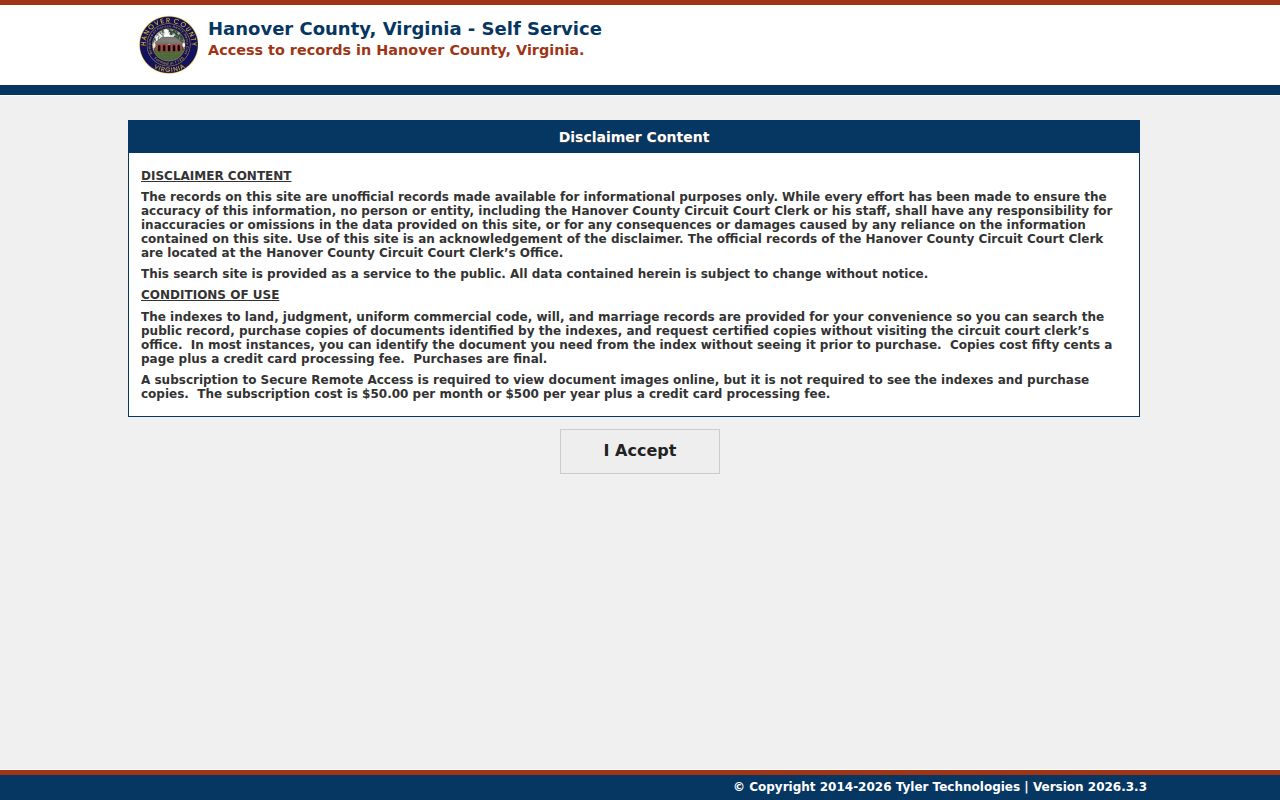
Check current access terms in the disclaimer first.
Hanover Deed Records Have More Than One Date Range
Hanover's deed records have no single online cutover date. The Clerk's deed, will, and marriage name indexes start in 1865, deed books run from 1959 to the present, and Historic Index or Historic Books material covers selected years from 1865 through 1967. An index can reach back earlier than a viewable book. Check the exact series and year before assuming coverage. The county's own pages also warn that older material may need the counter or the historical collections. Plan accordingly.
For an entry predating the modern image span, note the name, recording date, book or index reference, and legal description. Then ask the Clerk. The record may live in Self-Service, SRA, a paper volume, or the records room. A missing image proves nothing. Treat it as a viewing gap, not as proof that a deed went unfiled.
Follow Hanover's Grantor and Grantee Names
Hanover's grantor and grantee route shines once a parcel result gives you an owner or a deed reference. The grantee receives the interest. Search that same name later as a grantor. That back-and-forth is how a recorded chain gets traced. The Clerk's public text does not expose the full live search form or every field, so expect some limits. Broad name searches need narrowing. Try initials, a spouse or co-owner, a company suffix, a trust name, or an executor, then test each hit against its parcel description.
- Use the current parcel's GPIN and owner name to locate the newest deed entry.
- Read the grantee, grantor, date, and legal description; compare the land to the parcel.
- Search the grantee as a grantor to locate the next transfer, then repeat with the prior party.
- Record each book/page or instrument reference and note whether the next year is outside online coverage.
- Grantor
- The party conveying an interest in the instrument.
- Grantee
- The party who receives the stated interest.
- Chain of title
- The ordered trail of recorded transfers for one described property.
- Book/page or instrument number
- A locator to the Clerk's recorded document.
Match Hanover Deed Records to the Parcel They Describe
A name is a weak hook in Hanover County. Families repeat surnames, companies rename themselves, and trusts shift trustees, so two deeds can carry identical names and describe entirely different land. The stronger match is the parcel itself. Line up the deed's GPIN, legal description, subdivision, acreage, adjoining tracts, and instrument date against the parcel card before trusting any connection. A modern parcel may carry a four-digit/four-digit/four-digit GPIN such as 7796-94-6872, while an older book describes the same ground by lot and block, an old road, or metes and bounds. Do not expect the current street number to appear in a historic deed, because it often does not.
Consideration figures offer context only. They record what a deed says changed hands, not a current appraisal of worth. When a description shifts or a parcel splits, find the relevant plat and compare it with the predecessor tract. A title company or an attorney can sort out what a tangled chain legally means. The public index is a research tool, not a ruling on ownership.
Hanover's Recorded Document Alert Watches Name and GPIN Matches
Since July 1, 2025, the Clerk's free Recorded Document Alert service has let a registrant watch a personal or business name. It can also watch a property GPIN. When matching land, financing, judgment, will, or fiduciary filings are recorded, an email goes out. The goal is awareness. It does not stop fraud. It will not validate an instrument or replace a deed review. Nor will it excuse you from checking a notice against the actual recording and the parcel description. The Recorded Document Alert notice describes the service and its limits.
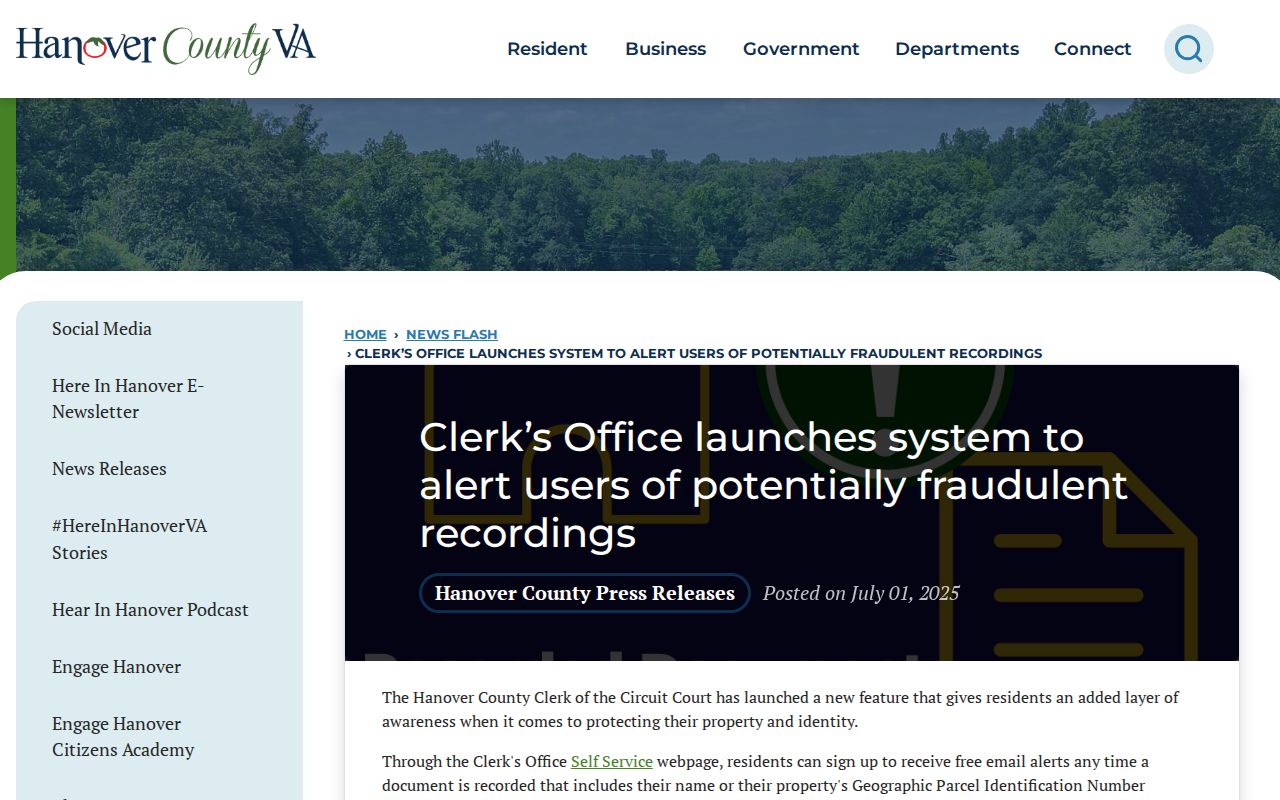
Call the Clerk to identify the record. From there, an owner can seek legal advice if anything looks wrong.
Hanover Deed Records Need a Historic Fallback
Hanover County dates to 1720, and its deed records carry both depth and loss. A fire in Richmond on April 3, 1865 destroyed many deed, court, and will records. The Clerk's office may have lost more. It was ransacked, including suit papers and marriage licenses. The county does still identify land books that survived from before 1865. So a gap in the deed index is not a dead end. It is a cue to check historic land books, chancery, probate, and archival catalogs. Don't stop there.
Old land books and modern instruments answer different questions. A land book tracks annual ownership plus assessed land and improvement values. A deed records a single conveyance. For older references, lean on the Clerk's material and the Library of Virginia. Its catalog can point to land-tax and chancery resources. Remember that a historical lead still needs a recorded transfer behind it. Only then can it support a title claim. The county's Deeds, Plats, and Self-Service page has the deed index. It also has current land-record access instructions.
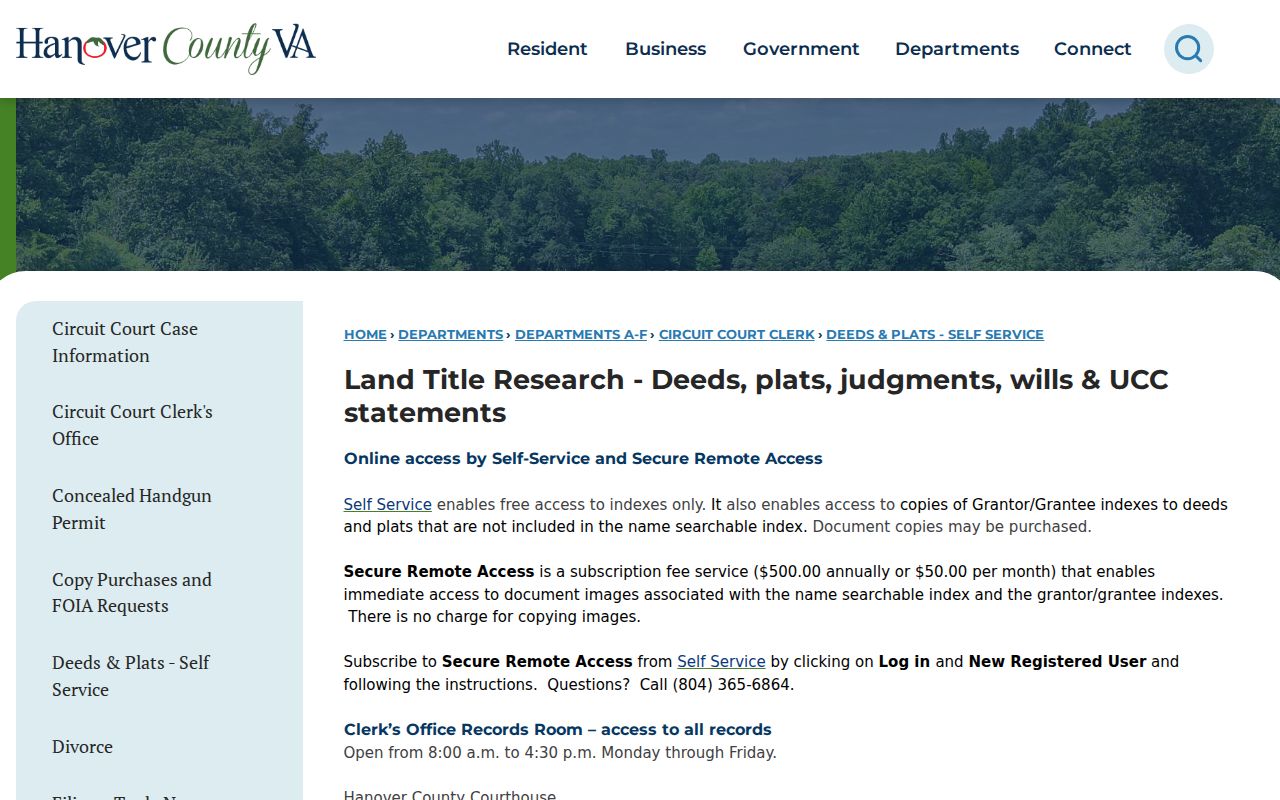
The Clerk's counter is the local fallback. When an online index ends before the volume or image needed for a chain check, the office can supply what the web does not.
Get a Copy of a Hanover Recorded Deed
Once the index points to a document, read the instrument through the Clerk's route. That route covers purchase, SRA, or an in-person visit. Self-Service copies run $0.50 per page plus a card-processing fee, and purchases are final. SRA images need a subscription, listed at $50 per month or $500 per year. The records room sits at 7530 County Complex Road, second floor. Hours are weekdays 8:00 a.m. to 4:30 p.m. The land-title line is 804-365-6151, option 5. Confirm hours and copying steps before you travel.
For a paper copy or a record outside the web index, give the Clerk the parties and the recording date. Also include the book/page or instrument number, plus the GPIN or legal description. When a record is not indexed, a narrow request to inspect it beats asking the office to rebuild a chain. Virginia FOIA covers county records that a specialized portal does not supply. For recorded deeds, though, the land-index and copy route is the right path.
The free index and the paid image do different jobs. An index match tells you which book, page, or instrument to request. Reading the deed itself reveals the granting language, reservations, restrictions, parties, and legal description. A book/page reference on a parcel card is only a lead. It does not prove the current parcel and the older instrument describe the same land. Compare lot, section, acreage, and prior references before treating a deed as the right link in a chain.
Older Hanover County property research runs into a cutoff that varies by collection. Indexes start at 1865. Selected historic books run through 1967. Electronic deed-book coverage is described from 1959 forward. When the year you need is not online, the Clerk or an archival catalog can point to another format. Write down the exact source and volume. That habit lets another researcher reproduce your deed records search from the start.
Recorded, not guaranteed. The Hanover deed index identifies instruments of record, but a search result is not a title opinion and may not show unrecorded interests. For a legal ownership conclusion, have the full chain reviewed by a title professional or attorney.