
What Hanover Property Tax Records Contain
Hanover reviews real estate annually and assesses it at full fair market value. Behind that number sit two separate records. The Assessor's parcel record holds the value judgment. The Treasurer's tax account carries the bill, the payments, and any delinquency. A third office, the Commissioner of the Revenue, runs programs such as land use and tax relief. Read them together. That way an owner can tell whether a figure on the page is an assessed value, a relief amount, a bill, or a payment entry.
| Field | What It Shows | Where |
|---|---|---|
| Annual assessment | Fair-market-value assessment for the tax year | Assessor |
| Land use | Qualification and deferred value for enrolled land | Commissioner of the Revenue |
| Tax relief or exemption | Approved program amount or taxable status | Commissioner / Treasurer |
| Bill and account status | Amount billed, paid, or still due | Treasurer |
| Payment history | Transactions associated with an account | Taxpayer Portal |
Even at a 100% assessment level, an assessed value is not a promised sale price. A bill folds in the tax calculation. It also covers the account status and any approved program. Keep the year in view when comparing figures. Annual assessments and payment events simply do not land on the same calendar.
Hanover Tax Records Use a Separate Account Finder
Hanover's tax-bill finder keys on the tax account, not the GPIN alone. Its fields ask for a Tax Type and an Account Number. A Last or Business Name is also required. Suppose an address search has already surfaced an owner or parcel clue. Use that clue to pick out the right account. Then compare the bill year and the property description. One caution applies. A parcel-viewer result says nothing about a balance or payment status.
| Finder field | What to enter | Why it matters |
|---|---|---|
| Tax Type | Select the category for the account | Separates real-estate bills from other tax types |
| Account Number | Use the account number if known | Direct match to the Treasurer's account |
| Last or Business Name | Use the billed owner or entity name | Useful when the account number is not at hand |
Open the Hanover bill and account finder to check the field labels.
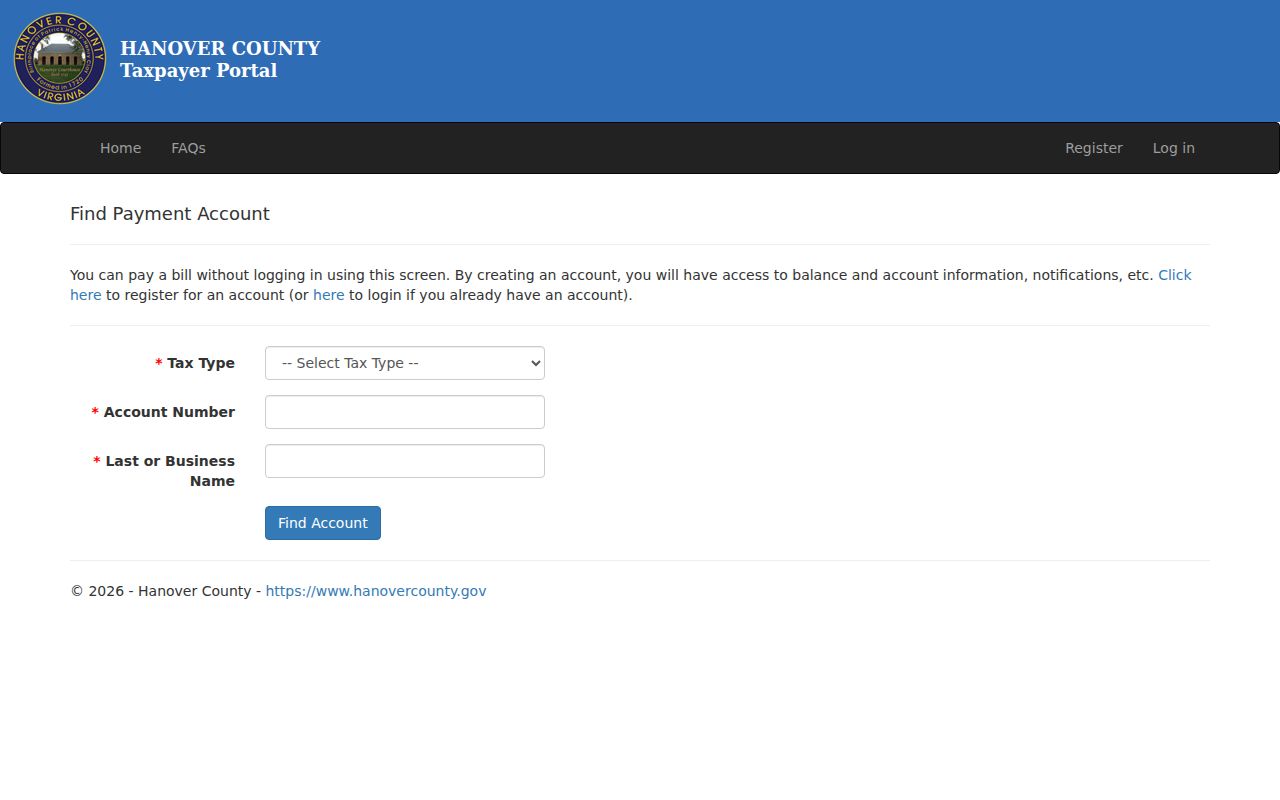
The finder identifies an account and nothing more; the linked bill or an official Treasurer response confirms the amount and its status.
Hanover Property Tax Records Use an Annual January 1 Basis
The January 1 basis anchors Hanover's assessment program. Real estate is valued at 100% of fair market value using conditions on that date. The Assessor's public parcel and map data refresh monthly. Refreshing is not revaluing. A sale, an improvement, a split, or a correction can slip in between the assessment date and a map update. So keep the year and date attached to every value you compare. An owner who disputes the assessment has a defined path. Start with a review by the Assessor. Move to a formal Board of Equalization appeal. Take the Circuit Court step only if needed. Comparable local sales, parcel details, condition facts, and the county's own appeal directions all belong in the file. Remember what the appeal decides: the county's value. A buyer's price or an independent appraisal is evidence, not an automatic replacement number.
Look Up a Hanover Property Tax Bill and Payment
Real-estate taxes in Hanover come due twice a year. The county tax page sets June 5 and October 5 as the regular deadlines and points owners to the Taxpayer Portal for payments and account history. A quick payment option works without a login. History and account actions, though, use the portal's sign-in workflow. Card payments carry a convenience fee, so read the payment screen before finishing a transaction. The Treasurer can also walk through in-person, phone, and prepayment routes.
- Find the account with its tax type and account number, or the billed last/business name.
- Open the bill or history for the right parcel and tax year; compare owner and address details.
- Check payment status with the Treasurer and review any current relief approval separately.
- If a balance is delinquent, read the county's tax-sale terms and confirm the current account directly.
- Assessed value
- The Assessor's annual fair-market-value conclusion for taxation.
- Tax bill
- The Treasurer's charge for the account and installment period.
- Land use
- A program that defers part of the tax burden on qualifying land; it is not a discount.
- Tax lien
- A claim related to unpaid taxes that should be checked with the Treasurer and Clerk.
Hanover Property Tax Records in the Taxpayer Portal
The Taxpayer Portal handles login, quick payment, tax and payment history, and account actions. Before trusting a balance, an owner should confirm the account, tax type, parcel address, year, and payment date. A bank confirmation or card receipt helps with follow-up. Still, the Treasurer account remains the county's record of payment. When a screen demands an account, try the public account finder first. Or call the Treasurer for the right route. The Hanover Taxpayer Portal is the entry point for payments and account history.
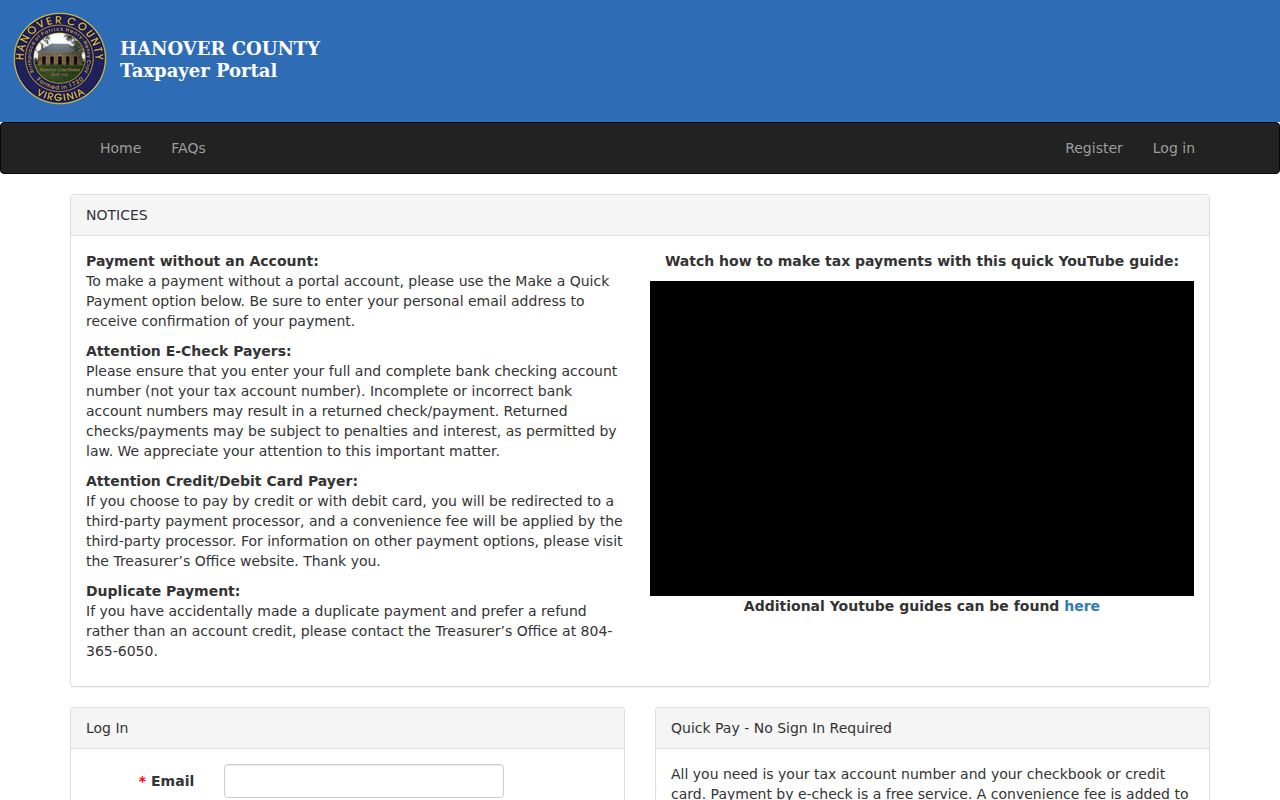
Quick payment and account history are two different tasks, so save the confirmation that matches the action actually completed.
Hanover Property Tax Relief Records Have Program Rules and Dates
Hanover's elderly or disabled real-estate tax-relief program runs on applications. The 2026 cycle carried a March 2 deadline, a $60,000 household-income limit, and a $400,000 net-worth limit. The net-worth test leaves out the home plus up to ten acres. Maximum annual relief was set at $3,500. Full applications recur every three years. The in-between years need only interim affidavits. Those figures belong to that cycle alone. Check them again when the next application window opens. Disabled-veteran relief is its own program, with a separate primary-residence rule and documentation. The Commissioner of the Revenue takes the applications. A taxpayer should keep parcel and account identifiers alongside proof of eligibility. Never read approval into a blank line on a bill. Ask the program office about current forms, deadlines, and supporting documents.
Hanover Land Use Defers Tax on Qualifying Land
Hanover County's land-use program shifts how qualifying farmland, forest, horticultural, or open-space parcels are taxed. It works as a deferral, not a discount. The lower current assessment should never be mistaken for a permanent exemption. Rollback charges can follow when the use of the land changes. Enrollment terms hinge on the program and the parcel's status. The Commissioner of the Revenue publishes the current application. The county guide covers qualifying use, acreage, timing, and any charge a change in use triggers.
When you review a parcel, place its land-use status beside the current assessment. Add any subdivision or development application on file. A zoning or plat change may influence future eligibility. Still, the property records establish no decision until the county processes the paperwork. Keep the effective year attached to any value or tax comparison. That keeps nothing out of context.
Hanover Property Tax Records Lead to a Separate Sale Process for Delinquency
Hanover's tax-sale page lays out a two-year delinquency threshold. A public auction follows, with deposits, premiums, and court confirmation. The notice itself is not a deed. It does not prove the parcel has changed hands. Read the Treasurer's current listing and auction terms, then confirm any completed transfer in the Circuit Court Clerk's land records, where the deed records actually live. Tax accounts, case files, and recorded instruments are separate sources, and each answers a different question.
Before relying on a sale notice, verify the parcel description, the balance, the dates, and the redemption or court terms that apply. The current state of title belongs with the custodian. The county may post an upcoming sale list only shortly before an auction. An older page is not a live docket. This path is ordinary property due diligence, not a shortcut around the recorded chain of title in Hanover County property records.
Appeal a Hanover Assessment Before the Formal Deadline
Hanover County points owners toward an informal review with the Assessor in January. That conversation comes first. If it leaves the issue open, a formal Board of Equalization appeal form is due by March 15. A Circuit Court option follows. Assemble the parcel number, the assessment year, the notice, comparable-sales support, photos or condition records, and the exact value question. The Board reviews assessments, not tax payment disputes. Billing and account problems belong with the Treasurer.
Shape the appeal around the field actually in dispute: land area, improvement characteristics, condition, or the value conclusion. Label the GPIN and year on each item. Sale evidence and tax-payment records serve different purposes, so keep them apart. An informal discussion never replaces the formal Board form. File it by the published deadline if the issue survives. The county's current instructions name the correct application and delivery method.
Pick the right office before sending anything. The Assessor handles value review. The Board hears formal assessment appeals. The Commissioner of the Revenue administers tax-relief applications, and the Treasurer posts bills and payments. A public record may show an amount without revealing which program or review produced it. Put the parcel ID on every request. That way the custodian can tell the bill account from a neighboring assessment on the tax roll.
After submitting, keep the dated application or appeal copy. Include any county acknowledgment with the parcel's tax year. The January informal discussion, the March Board deadline, yearly billing dates, and the annual relief cycle are distinct events on the calendar. A record from one cycle cannot prove a later approval or payment. Check the current account and the current program notice for that year's status.
The County's assessment appeal instructions outline the informal and formal steps.
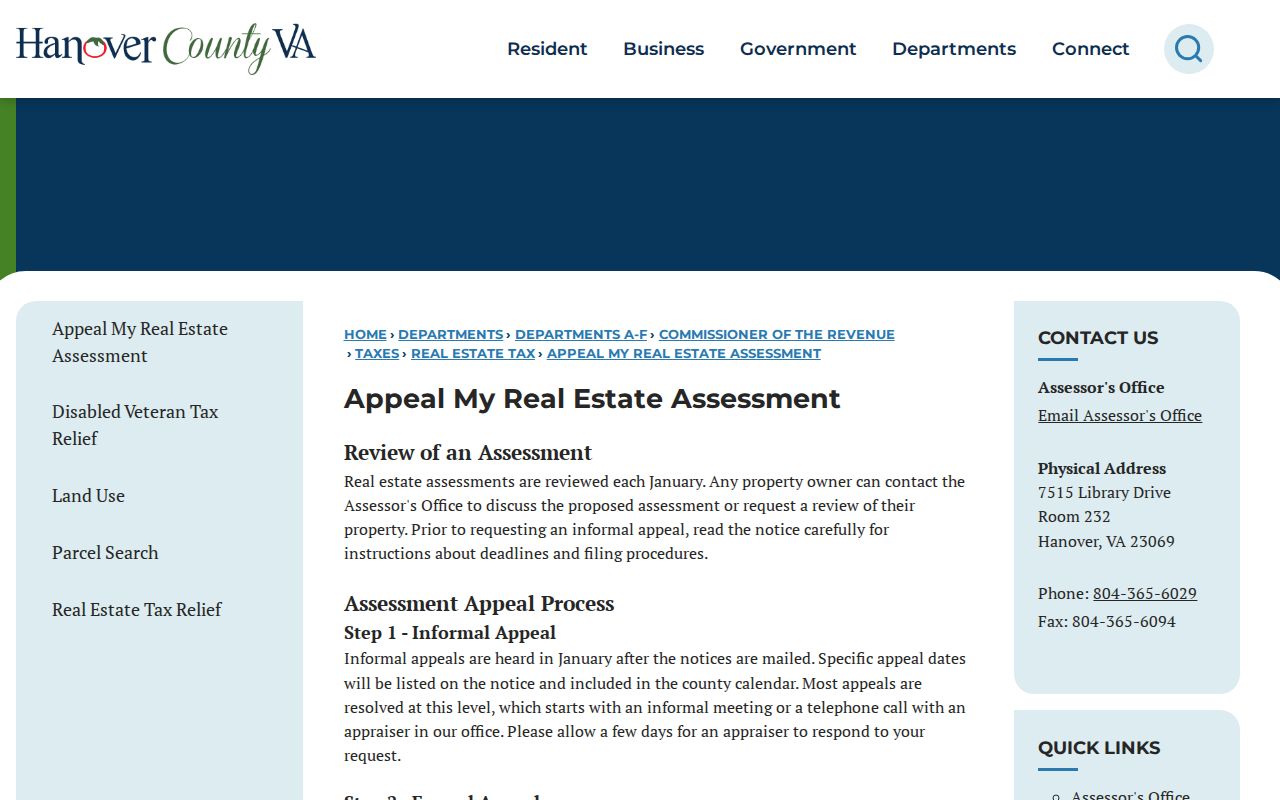
The published appeal page shows the current form and filing method before evidence goes in.
Appeal window. Hanover's instructions place informal review in January and the formal Board of Equalization filing deadline on March 15. Confirm the current cycle's dates on the County form before filing.