
Trace Former Owners of a Hanover Property by Era
Ownership history in Hanover does not live in one unbroken online chain. The records are scattered across series. The modern Clerk index, selected Historic Index material, annual land books, chancery files, and recorded plats each offer a different clue. A deed proves a conveyance. A land book shows who was assessed that year. A chancery index can reveal a partition or dispute, so match the source to the question, then tie its description to the parcel's GPIN.
| Source | Years It Covers | Where Held | What It Shows |
|---|---|---|---|
| Clerk name index | Described from 1865 | Self-Service / Clerk | Grantor, grantee, instrument lead |
| Deed books online | 1959 to present description | Clerk / SRA | Modern recorded conveyances |
| Historic Index and Books | Selected 1865-1967 material | Self-Service / Clerk | Earlier index and book references |
| Land books | Microfilm 1782-1927; paper most years 1850s-2004 | Clerk / Commissioner / LVA | Annual owner and assessed land/improvement value |
| Chancery index | Hanover suits, 1831-1913 | Library of Virginia index; originals at Clerk | Partition, estate, debt, and land disputes |
Recent transfers are easiest. Search the Clerk's grantor and grantee entries, then read the deed itself. For earlier decades, follow the prior-reference line to the older instrument, and check the historic index and land books along the way. An estate or a lawsuit can interrupt a chain. When one does, move into probate or chancery. Remember that these series overlap in dates without being substitutes; a land-book entry proves assessment, not conveyance.
Walk the Hanover Deed Chain Backward One Grantee at a Time
Start with the newest deed on the parcel. Note its grantee. That party becomes your grantor in the next search. Repeat the leap until the index stops reaching the era you need. Hanover's Clerk offers free indexes and separate paid images, and the index alone never shows the full instrument. Log every step. Recording date, parties, deed type, reference, GPIN, and description keep a similar name or neighboring tract out of your timeline.
- Find the latest deed and compare its legal description with the current parcel.
- Record the current grantee and search that name as a grantor in the next earlier transfer.
- Repeat with the new grantee, keeping every date and instrument reference.
- At an online coverage edge, use historic indexes, paper books, land books, or archival catalogs.
- Grantor
- The party conveying the interest in a deed.
- Grantee
- The recipient named in that instrument.
- Chain of title
- The ordered series of recorded transfers affecting the described land.
Hanover Former Owner Searches Meet an Online Coverage Edge
Coverage varies by series. Name indexes reach back to 1865. They cover deeds, wills, and marriages. Deed books run from 1959 to the present. Selected Historic Index and Historic Books materials span 1865 through 1967. No verified cutover year applies to every deed series, so check a book's exact title and date in Self-Service before assuming an old instrument has a searchable image.
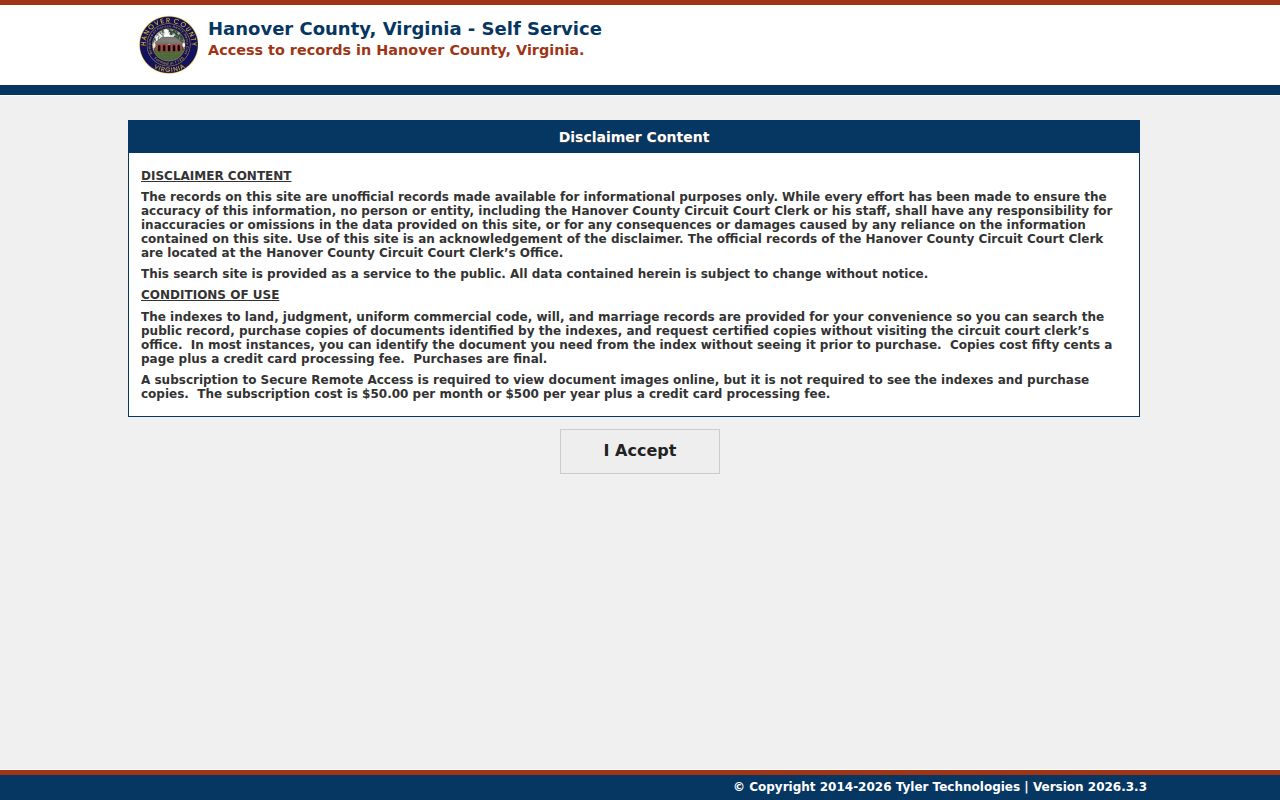
The Self-Service disclaimer spells out the free index and paid image split for the Clerk's system.
When an index result predates the online deed books, its reference points you to the right historic volume. Ask for that volume or a counter copy.
Former Hanover Owners Are Found Through Deed Descriptions
Older deeds rarely use a modern street number. They call land by metes and bounds, by an adjoining owner, or by a historic road, district, lot, or section. Carry the written description forward along with acreage, adjoining tracts, and any prior deed reference. Divisions complicate things. If the parcel was split, compare the current GPIN to its parent tract and find the recorded plat that created the lots. An address fails as a historical key.
- Start from the current grantee and the recorded deed's land description.
- Search the grantor/grantee index for that party's prior acquisition.
- Compare lot, acreage, road, adjoining property, and plat references at each step.
- Move to the Clerk's historic books or land books when the online record ends.
- Grantor / grantee
- The conveying party and receiving party named in the deed.
- Chain of title
- The ordered sequence of recorded ownership transfers.
- Legal description
- The written description that identifies land independently of a current street address.
Hanover Former Owners Appear in Annual Land Books
Hanover's land books run deeper. Microfilm runs from 1782 through 1927. Paper books survive for most years from the 1850s through 2004. Electronic and microfiche books carry the sequence past 2004. Entries show yearly owners and assessed values. Find an entry with the owner's name, district, tax year, and neighboring land, then tie it to the deed, plat, will, or court record that explains the transfer.
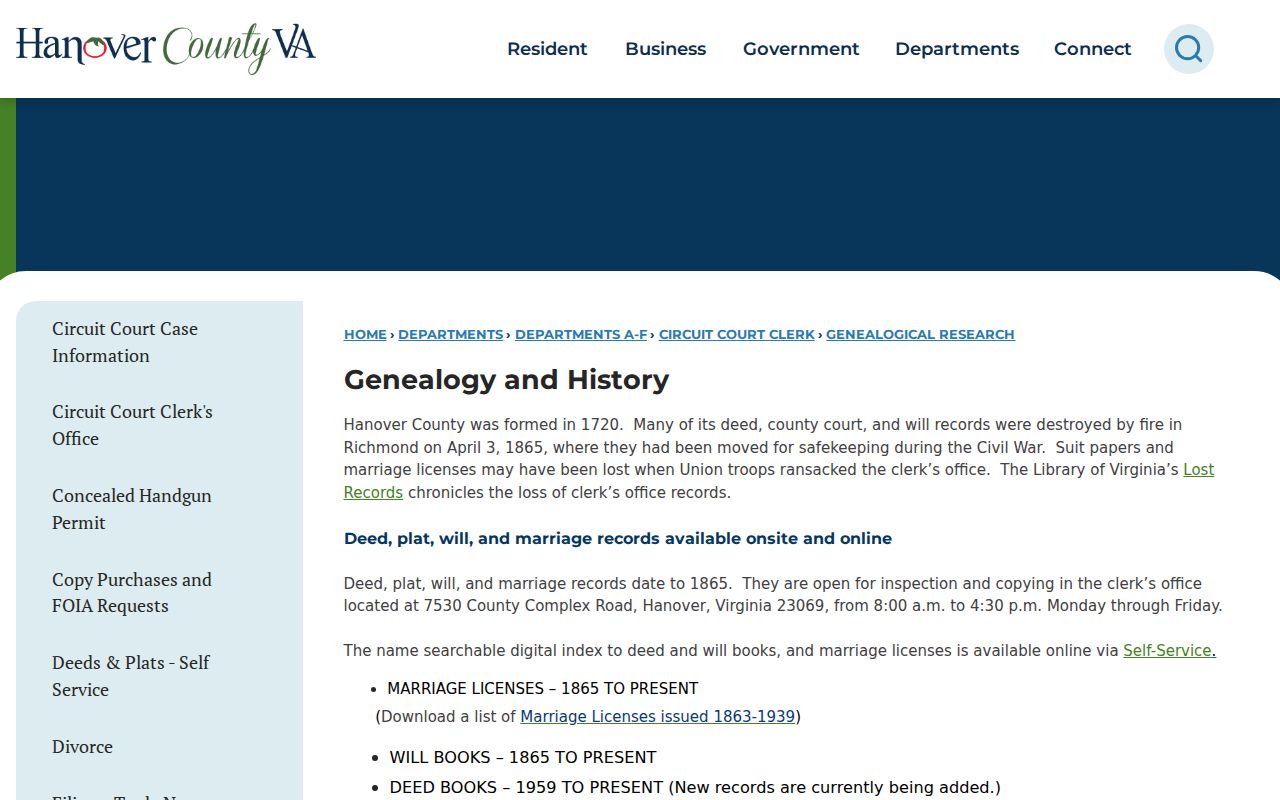
The County's historic research guide lists the land books and other surviving series.
A land-book name is only a lead. A deed or court order documents the conveyance. Use the old books to bridge sparse stretches of an online deed search. Just remember what a yearly entry proves: assessment and ownership at a point in time.
Compare years side by side. Spot the year a name or tract changes, then test the reason in deeds, probate, or chancery. The tax roll alone never proves the instrument.
Hanover's 1865 Record Loss Leaves a Known Gap
Hanover's records story includes a hard chapter. The Richmond fire of April 3, 1865 destroyed deed, county-court, and will records that had been moved for safekeeping. The Clerk's office was also ransacked. Suit papers and marriage licenses may have been lost then. Still, the loss is not a clean line. Some older books survive, and selected historic material remains available.
Record any gap near the war. Then search surviving land books, chancery references, probate, and neighboring-owner descriptions. A missing file proves nothing. Test each archival lead against the legal description and the later deed chain.
The Library of Virginia catalog is one route for land-tax and chancery research, and county historical pages help identify surviving series.

Use the catalog to find a collection reference. Then confirm how to access the original.
Prior Hanover Owners and Chancery Records Explain Name Changes
Chancery suits often explain sudden name changes. The Library of Virginia's Chancery Records Index covers Hanover County from 1831 through 1913. Suits covered land partition, estates, debt, divorce, and business. Originals are fragile and generally closed. Even so, a chancery case is only a lead, not a conveyance. It can show why a parcel passed among heirs, so search by party and date, then match the suit's land description to your parcel.
One register deserves special attention. The Freedmen's Marriage Register lists 550 African American couples whose pre-1865 marriages were validated by Virginia's 1866 act. It can resolve a surname change in a postwar property chain. Marriage and vital records add family context. They never replace the deed or probate authority that transferred the land.
Separate family evidence from transfer evidence. A will, chancery suit, or marriage record explains names, while an executor's deed, court order, or recorded conveyance documents how the land interest moved. Follow people and parcels through each source. Mark any relationship inference as such until a land instrument confirms the transfer.
How Far Back Hanover Former Owner Records Can Reach
Hanover ownership evidence has no single start date. Each source reaches a different point in the past. The modern deed index, selected historic books from 1865 through 1967, and land-book microfilm beginning in 1782 each start at a different era, and the chancery index runs from 1831 through 1913. A careful chain makes those boundaries visible. It does not imply a complete electronic record reaching back to the county's founding. If the trail moves to a land book, mark it as an annual assessment record and keep searching for a deed, will, court order, plat, or probate transfer.
Lawful use. Research former owners for house history, title review, estate work, and property diligence. Do not use old records to track, harass, threaten, or harm a living person.