
How to Find Who Owns a Hanover Property
Every solid Hanover ownership search runs the same loop. Start at a location, like an address or subdivision. The GPIN then links the county map, assessor records, permits, and alert systems. The assessor's owner-of-record entry is a current-roll clue, though Hanover's public instructions don't expose every live owner field in plain text. Once the parcel is fixed, the Clerk's index points to the newest grantee and the deed that describes the conveyance. That recorded instrument is the anchor. Entity filings answer a different question. They show who represents a company, not whether it holds title.
- Use the address or subdivision in CivQuest/eTRAKiT and record the GPIN and parcel description.
- Read the owner and mailing fields on the live parcel card, noting that parcel data refresh monthly.
- Find the latest deed through Self-Service or SRA and compare its grantor, grantee, date, and land description.
- If the grantee is an entity, check Virginia SCC CIS for its status and agent, then return to the deed for title evidence.
Where Hanover Property Owner Information Is Recorded
Hanover scatters its ownership clues across several systems. The Assessor/GIS parcel card ties a current roll entry to the land. The Circuit Court Clerk keeps the recorded conveyance. The SCC database identifies business entities and their registered agents, while eTRAKiT can surface a permit applicant or linked property activity. Neither one proves title. A permit contact is not automatically an owner, and a registered agent is not a deed grantee, so match each record to the question you're actually asking.
| Source | Owner Info It Gives | Access |
|---|---|---|
| Assessor parcel card | Owner-of-record and mailing clues when shown | Public parcel application |
| Circuit Clerk index | Named grantor/grantee and recorded instrument | Index is free; images have access fees |
| Virginia SCC CIS | Entity status, filing history, registered agent | Official online lookup |
| eTRAKiT property result | Parcel, deed reference, project and permit activity | Public search |
An owner of record is a formal label. It names the party in the public ownership record. It does not say who lives there. A tax mailing address can be a business, a trust, a post-office box, or an out-of-county address. For the legal transfer, compare the newest grantee and the full legal description in the deed. The current-owner guide digs into the roll's present name and its update timing.
A Hanover Property Owner Lookup Needs a GPIN Match
Hanover's sample eTRAKiT result for 9495 Atlee Road is a good demo. It shows the parcel-first method. The result lists Mechanicsville, VA 23116, GPIN 7796-94-6872, the Atlee subdivision, zoning, 3.423 acres, school and tax-rate fields, and deed book 3428, page 737. The sample says nothing about the current owner. It shows the cross-reference fields that connect one parcel to its deed, map, and permit records.
The County's sample eTRAKiT result displays the parcel identifiers to check against the Clerk's record. Those numbers, not the name, carry the lookup. Match them across systems.
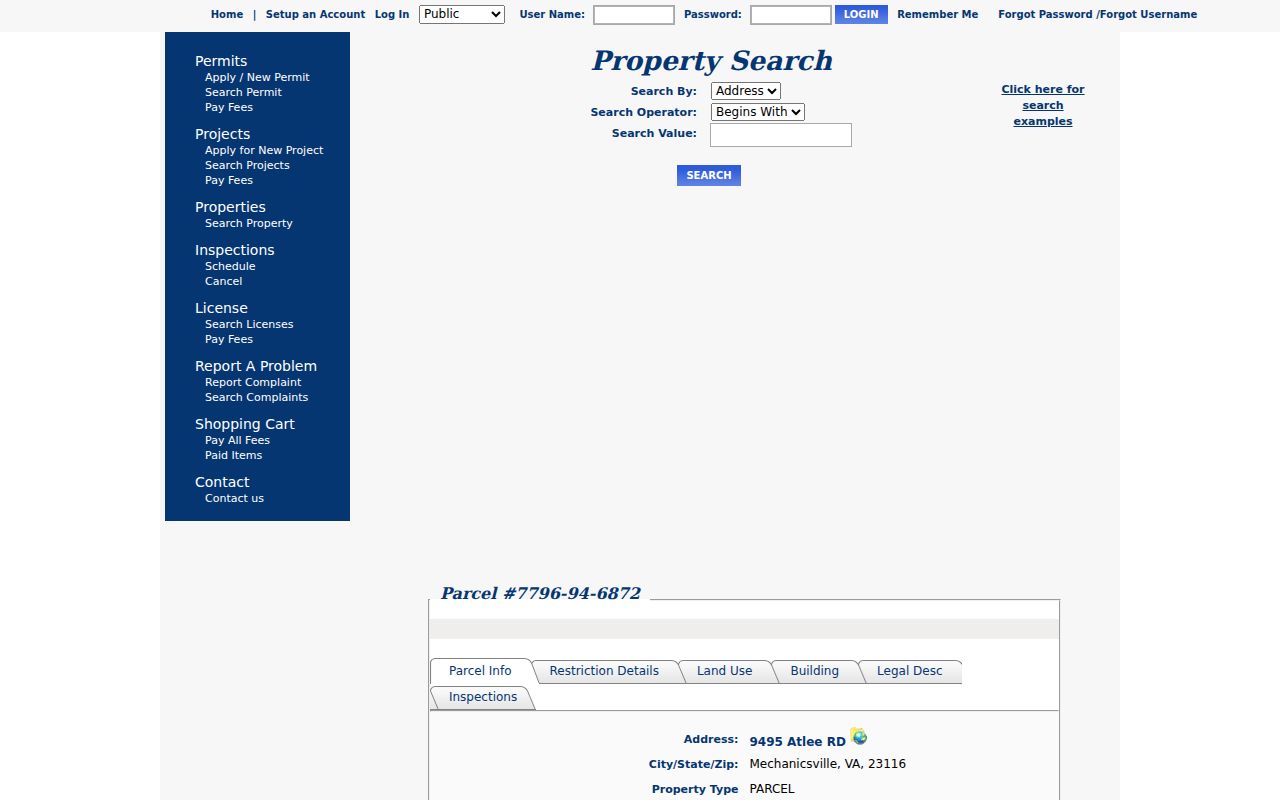
A matching deed reference settles an ownership question far better than a similar-sounding name. So does a GPIN.
Treat the example as an identification model, never as a current-owner result for that address. The locality and subdivision are context. The GPIN and deed book/page are the cross-system keys. The parcel card's live owner entry needs its own check. And when the identity or extent of a transfer matters, open the full recorded deed. Do not settle for the index line. One name can sit on several Hanover parcels. The legal description is what tests whether the instrument covers the lot you care about.
Hanover Owner Records Can Lag a Recent Closing
Hanover refreshes its parcel and GIS data monthly. That cadence is not an instant closing feed. The county publishes no guaranteed number of days between a closing and an owner-field change. A deed recorded yesterday can still be newer than what the assessor display shows. When names disagree, compare the recording date, grantee, legal description, and GPIN, and ask the Clerk or Assessor which record needs attention.
Tax bills add a date clue of their own. Hanover bills the January 1 owner of record. A seller may have to forward a bill after a later sale. That billing rule decides nothing about ownership. It just explains why a tax account can still show the earlier party while the deed already records the transfer.
The two systems keep separate clocks. A monthly refresh means the Clerk's index and the assessor card should be compared by their own dates, not treated as one synchronized feed. Never assume they match. For a just-recorded sale, the newest indexed deed is direct evidence. It names the grantee. The roll is the cross-check. It may just be waiting on the next refresh before the Hanover County owner of record catches up.
Hanover Property Owners May Appear as Trusts or Companies
Ownership in Hanover County is not always held by a person. Trusts, LLCs, corporations, estates, trustees, and executors all appear in the property records. You will find them in the grantor and grantee index. Search the exact name first. Then try the legal suffix, initials, a trustee's name, an executor's name, and spouse or co-owner variants. The Virginia State Corporation Commission offers a search of its own. It can reveal entity status, amendments, and registered-agent filings. That helps clarify who may speak for an organization. Only the recorded deed ties that organization to the land, though. An eTRAKiT applicant or a contractor is not the owner of record.
Privacy limits do exist in public records. Some protected participants use a substitute address through Virginia's Address Confidentiality Program. Sealed court material or redactions can restrict access. When a public source withholds a personal address, do not try to infer a protected residence from other fields. Keep the ownership question on the parcel and its legal record.
For an LLC result, run the name exactly as the deed spells it, punctuation and suffix included. The SCC's CIS record is useful only for entity status and filing history. The registered agent receives legal notices but is not necessarily an owner. A trust's public deed may show a trustee acting in that role. An executor or administrator may sign a transfer for an estate. In the Hanover County property records, the deed is the evidence. Its legal description connects any of these names to the parcel.
Hanover Property Owners Can Watch a GPIN with the Recorded Document Alert
The Clerk's Recorded Document Alert can watch a name or a GPIN on your behalf. Registration is free. Once an owner has verified the right parcel key, the service sends email notice of land, financing-statement, judgment, will, or fiduciary filings against that GPIN or name. The service began July 1, 2025. An alert only raises awareness. It cannot prevent a filing or prove that a matched document is fraudulent. Read Hanover's alert announcement for the scope of the notices.
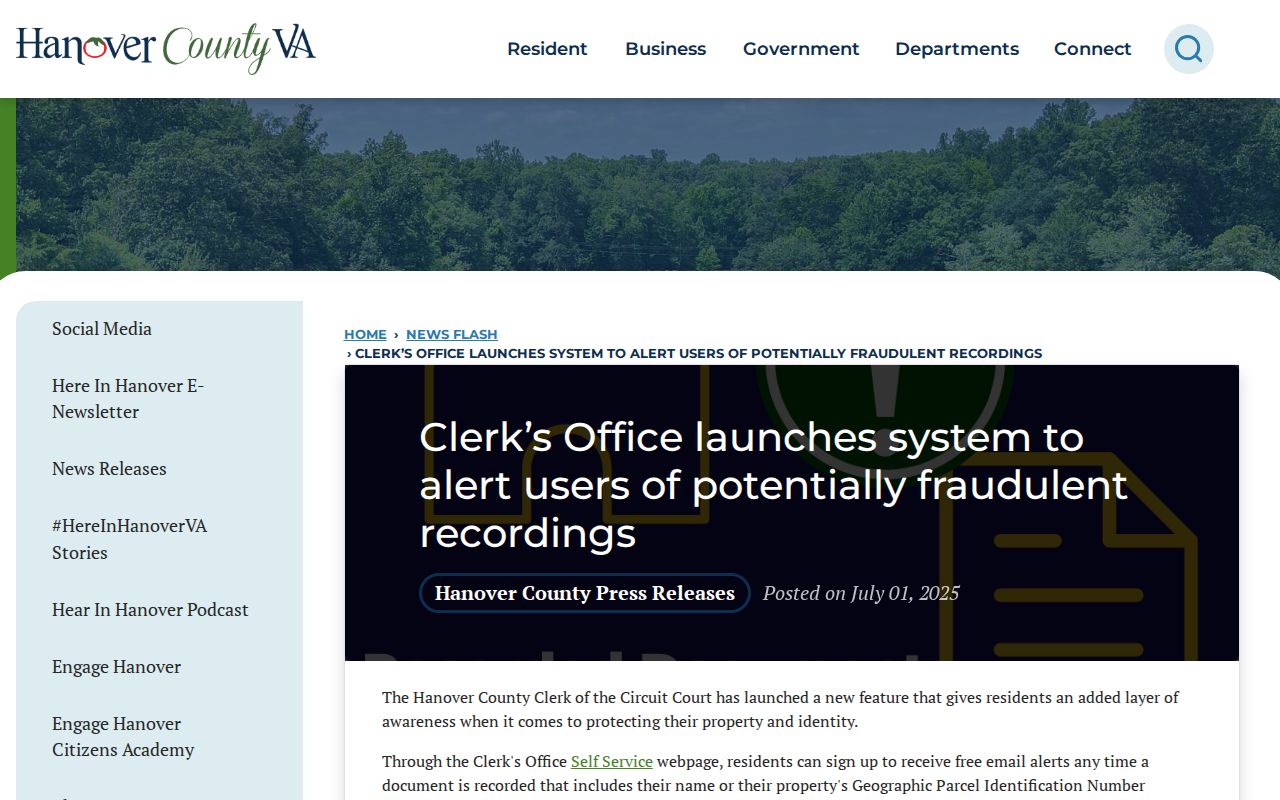
When a notice arrives, identify the instrument and the parcel before deciding on any follow-up. A name notification is not automatically a change in ownership. Alerts can match financing statements, judgments, wills, and fiduciary documents as well as land transfers. Compare the filing type and the parties. Check the recording date, the GPIN, and the legal description before drawing a conclusion. An owner who registers a name should confirm the actual property connection behind a match. That step comes before any fraud report or any assumption that a transfer occurred.
A Hanover Owner's Mailing Address Is Not the Situs
The situs is where the property sits. The mailing address is where the tax bill goes. A farm, a rental parcel, a trust, an estate, or a company-owned tract in Hanover County may carry a separate mailing address. That address can differ from the situs. The distinction helps you land on the correct tax account. But it proves neither residence nor permission to reach someone through another route. An owner must be contacted about a property matter at times. Use the public mailing channel. Respect any confidentiality restrictions that apply.
For a name-based match, carry the mailing and situs fields alongside the GPIN, subdivision, and deed reference. When a result looks incomplete, the record custodian can explain that field. No commercial directory stands in for the county's ownership instrument in the property records.
What a Hanover Property Owner Search Cannot Prove
A public owner name cannot prove everything. It does not show occupancy, explain every private agreement, or guarantee clear title. Each Hanover County record serves one purpose. A parcel card is roll evidence. A permit names the parties to an application. An SCC record describes an entity. The deed remains the primary recorded transfer evidence. A full title review may still need judgments, easements, probate, and earlier instruments. A record may be missing or inconsistent. Confirm with its custodian and a qualified title professional.
Lawful use. Owner information is for lawful property research, purchase diligence, and civic use. Do not use a name, map, or mailing address to stalk, intimidate, harass, or harm a person.